To apply for a commercial driver license in Texas, you must verify your eligibility, complete Entry-Level Driver Training (ELDT), get a Commercial Learner’s Permit, pass the knowledge and skills tests, and hold your permit for at least 14 days before taking the road test. Most applicants finish the process in three to seven weeks.
A commercial driver’s license opens the door to one of the most reliable careers in the country. Trucks move roughly 70% of all freight in the United States, and Texas—with its busy ports, highways, and growing population—needs skilled drivers more than ever. If you want to drive an 18-wheeler, a city bus, or a delivery truck, a CDL is your ticket in.
The process can feel overwhelming at first. There are different license classes, medical requirements, training rules, and several tests to pass. Miss one step, and your application could stall for weeks.
This guide walks you through everything you need to know to apply for a commercial driver’s license in Texas. You’ll learn about CDL classes, eligibility rules, required documents, costs, timelines, and the full ten-step application process. By the end, you’ll have a clear roadmap to start your trucking career with confidence.
What Is a Commercial Driver’s License (CDL)?
A Commercial Driver’s License (CDL) is a special license that allows you to legally operate large or heavy vehicles for work. The federal government sets the baseline rules, while the Texas Department of Public Safety (DPS) handles licensing within the state.
You need more training and testing for a CDL than a standard Texas driver license class because commercial vehicles are bigger, harder to control, and carry greater risk on the road.
What Does a CDL Allow You to Drive?
A CDL lets you operate commercial motor vehicles based on their weight and purpose. Depending on your license class, this can include:
- Tractor-trailers and 18-wheelers
- Dump trucks and tow trucks
- City and school buses
- Delivery box trucks
- Tanker vehicles carrying liquids or gas
- Vehicles transporting hazardous materials
Who Needs a CDL in Texas?
You need a CDL in Texas if you plan to operate any of the following:
- A vehicle with a gross weight rating of 26,001 pounds or more
- A vehicle designed to carry 16 or more passengers, including the driver
- Any vehicle used to transport hazardous materials that require placards
If your job involves driving these vehicles, the law requires a valid CDL.
CDL Classes Explained in Texas
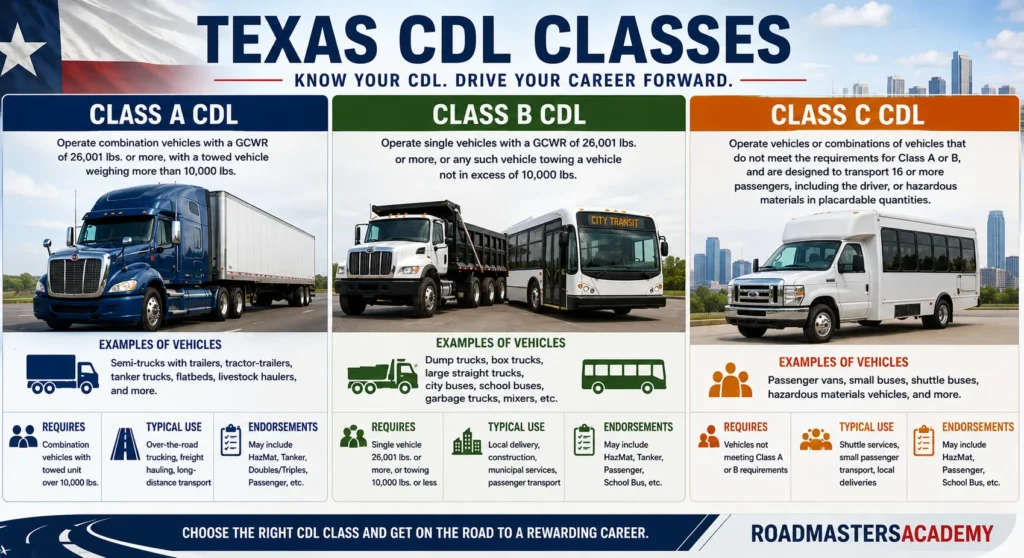
Texas offers three commercial license classes: A, B, and C. Each class matches a different type of vehicle and unlocks different jobs. Choosing the right one is the first big decision in your CDL journey.
What Is a Class A CDL?
A Class A CDL is the most versatile commercial license. It allows you to drive a combination of vehicles with a combined weight rating of 26,001 pounds or more, as long as the towed vehicle weighs more than 10,000 pounds.
Types of vehicles you can drive with a Class A license:
- Tractor-trailers
- Truck and trailer combinations
- Tanker vehicles
- Livestock carriers
- Flatbed trucks
Career opportunities:
- Long-haul and regional trucking
- Freight and logistics driving
- Heavy equipment hauling
Benefits of obtaining a Class A license:
A Class A license offers the widest range of jobs and often the highest pay. In many cases, holding a Class A CDL also lets you operate Class B and Class C vehicles, giving you more flexibility in the job market.
What Is a B Class License?
A Class B license, sometimes called a B class license, allows you to drive a single vehicle weighing 26,001 pounds or more, or to tow a trailer weighing 10,000 pounds or less.
Eligible vehicles:
- Straight trucks and box trucks
- City and transit buses
- Dump trucks with small trailers
- Large delivery vehicles
Common jobs:
- Local delivery driving
- City bus driving
- Garbage and recycling truck operation
- Construction and dump truck work
What Is a Class C Driver License?
A commercial Class C driver license covers vehicles that don’t meet the size limits for Class A or B but still require special handling. It focuses on passenger transport and hazardous materials.
Passenger transportation:
A Class C driver license lets you operate vehicles designed to carry 16 or more passengers, including the driver. Think shuttle vans, small buses, and passenger transport vehicles.
Hazardous materials transportation:
You also need a Class C license to transport hazardous materials in quantities that require placards, even in smaller vehicles.
It’s worth noting that the standard, non-commercial Texas driver license most people carry is also called a Class C license. The commercial version requires extra testing and endorsements.
Texas Driver License Class Comparison
Feature | Class A CDL | Class B CDL | Class C CDL |
|---|---|---|---|
Vehicle weight | 26,001+ lbs combination, trailer over 10,000 lbs | 26,001+ lbs single vehicle | Below A/B limits |
Common vehicles | Tractor-trailers, tankers | Buses, box trucks, dump trucks | Shuttle vans, hazmat vehicles |
Passenger capacity | Varies with endorsement | Varies with endorsement | 16+ passengers |
Typical jobs | Long-haul trucking | Local delivery, transit | Passenger and hazmat transport |
Flexibility | Highest | Moderate | Specialized |
Eligibility Requirements to Apply for a Commercial Driver License in Texas
Before you apply for a commercial driver license in Texas, you must meet several eligibility requirements set by the Texas DPS and federal law.
Age Requirements
- 18 years old: You can drive commercial vehicles within Texas state lines (intrastate) at age 18.
- 21 years old: You must be 21 to drive across state lines (interstate), transport hazardous materials, or carry passengers commercially.
Residency Requirements
You must be a Texas resident and provide documents that prove you live in the state. Out-of-state CDL holders moving to Texas must transfer their license within 90 days.
Medical Certification Requirements
Most CDL applicants must pass a physical exam from a certified medical examiner listed on the National Registry. This results in a Medical Examiner’s Certificate, often called a DOT medical card.
Vision Standards
You must have at least 20/40 vision in each eye, with or without corrective lenses. You also need a field of vision of at least 70 degrees in each eye and the ability to recognize standard traffic signal colors.
Other Eligibility Criteria
- A valid Texas driver license
- A clean enough driving record (serious violations can disqualify you)
- Proof of legal presence in the United States
- No CDL disqualifications from other states
Documents Required for CDL Application
Bring the correct documents to your DPS appointment to avoid delays. You’ll typically need:
- Proof of identity: A U.S. passport, birth certificate, or certificate of citizenship.
- Social Security documentation: Your Social Security card or a document showing your number.
- Texas residency proof: Two documents such as utility bills, a lease agreement, or bank statements.
- Medical Examiner’s Certificate: Your DOT medical card from a certified examiner.
- Existing driver license: Your current valid Texas driver license.
Double-check the DPS website for the most current document list before your visit. Requirements can change, and arriving prepared saves time.
How to Apply for a Commercial Driver License in Texas
Follow these ten steps to apply for a commercial driver license in Texas. Each step builds on the last, so completing them in order keeps your application moving smoothly.
Step 1: Verify Eligibility Requirements
Why it’s required: Confirming you meet the age, residency, and medical standards prevents wasted time and money.
Common mistake: Applicants often skip the medical exam and show up without a valid DOT medical card.
Tip: Make a checklist of every requirement and gather your documents before doing anything else.
Step 2: Complete Entry-Level Driver Training (ELDT)
Why it’s required: Federal law requires ELDT from a provider on the FMCSA’s Training Provider Registry for first-time CDL applicants and certain upgrades.
Common mistake: Choosing a training school that isn’t on the official registry, which makes your training invalid.
Tip: Always confirm your school is FMCSA-approved before paying any fees.
Step 3: Apply for a Commercial Learner’s Permit (CLP)
Why it’s required: A CLP lets you practice driving a commercial vehicle with a licensed CDL holder beside you.
Common mistake: Forgetting required documents, which forces a second trip to the DPS office.
Tip: Book your DPS appointment online in advance to skip long walk-in waits.
Step 4: Pass CDL Knowledge Tests
Why it’s required: You must prove you understand commercial driving rules, safety, and vehicle operation before getting your permit.
Common mistake: Underestimating the tests and failing to study the Texas CDL Handbook.
Tip: Take free online practice tests until you score consistently high.
Step 5: Hold Your CLP for the Required Period
Why it’s required: Texas requires you to hold your CLP for at least 14 days before taking the skills test. This ensures you get real practice time.
Common mistake: Trying to schedule the skills test too early.
Tip: Use the waiting period to log as much supervised driving as possible.
Step 6: Schedule the CDL Skills Test
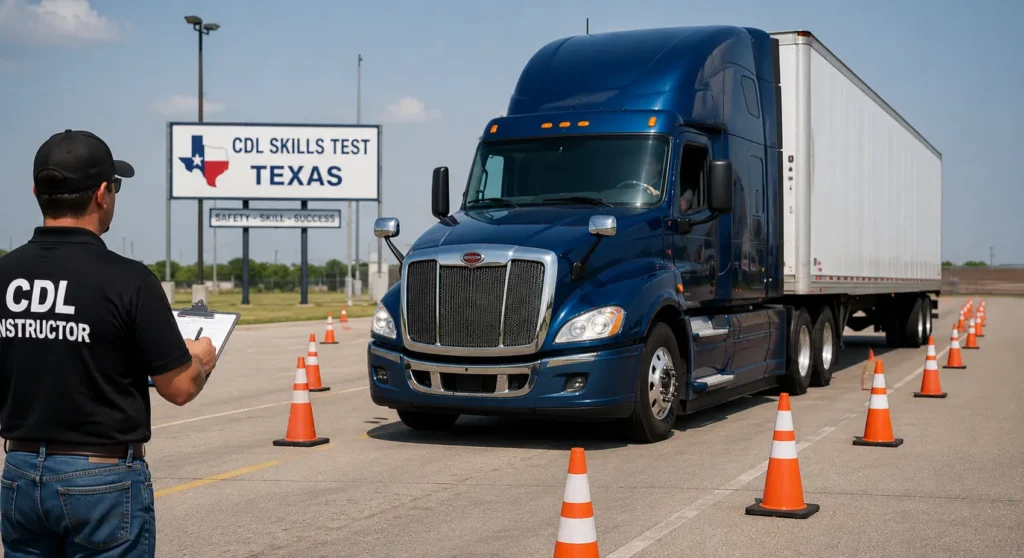
Why it’s required: The skills test measures your real-world ability to operate a commercial vehicle safely.
Common mistake: Showing up in a vehicle that doesn’t match the class you’re testing for.
Tip: Confirm the testing vehicle meets the requirements for your CDL class.
Step 7: Pass the Vehicle Inspection Test
Why it’s required: This test checks that you can spot safety problems before driving.
Common mistake: Memorizing parts without understanding what each one does.
Tip: Practice a full inspection out loud until it becomes second nature.
Step 8: Pass the Basic Control Skills Test
Why it’s required: This part measures your control of the vehicle through maneuvers like backing up and parking.
Common mistake: Rushing maneuvers and going outside the marked boundaries.
Tip: Practice slow, controlled movements at a training yard before test day.
Step 9: Complete the Road Test
Why it’s required: The road test proves you can drive safely in real traffic.
Common mistake: Failing to signal, check mirrors, or maintain safe following distances.
Tip: Stay calm, narrate your actions, and drive defensively throughout the test.
Step 10: Receive Your Texas CDL
Why it’s required: After passing every test, the DPS issues your official commercial driver license.
Common mistake: Forgetting to pay the licensing fee or update endorsements.
Tip: Review your license details on the spot to confirm everything is correct.
How Long Does It Take to Get a CDL in Texas?
Many applicants want to know how long it takes to get a CDL before they start. The answer depends on your training pace, scheduling, and test results.
- Training timeline: ELDT programs usually take three to seven weeks, depending on whether you train full-time or part-time.
- Permit timeline: Getting your CLP can happen in a single day if you pass the knowledge tests.
- Testing timeline: After the mandatory 14-day CLP holding period, you can schedule your skills test based on availability.
- Typical completion timeframe: Most people complete the full process in three to seven weeks.
Factors that may affect processing time:
- Test scheduling backlogs
- Failed tests that require retakes
- Missing documents
- Part-time versus full-time training
Stage | Estimated Time |
|---|---|
ELDT training | 3–7 weeks |
Knowledge tests and CLP | 1 day |
CLP holding period | 14 days minimum |
Skills test scheduling | 1–3 weeks |
Total | 3–7 weeks (average) |
How Much Does It Cost to Get a CDL in Texas?
Understanding how much it costs to get a CDL helps you budget properly. Costs vary based on your training school and endorsements, but here’s a general breakdown.
- CDL permit fees: Around $25 for the Commercial Learner’s Permit.
- CDL license fees: Roughly $61 for a standard commercial driver license.
- Medical examination costs: Typically $50 to $150 for a DOT physical.
- Training school costs: The biggest expense, ranging from $1,500 to $8,000 depending on the program.
- Endorsement fees: Usually $10 to $25 per endorsement, plus testing fees.
Expense | Estimated Cost |
|---|---|
Commercial Learner’s Permit | ~$25 |
CDL license | ~$61 |
DOT medical exam | $50–$150 |
Training school | $1,500–$8,000 |
Endorsements | $10–$25 each |
Always confirm current fees with the Texas DPS, since pricing can change over time.
CDL Endorsements Available in Texas
Endorsements add special permissions to your CDL. Each one requires extra testing and, in some cases, a background check.
Passenger Endorsement
The Passenger (P) endorsement lets you drive vehicles carrying a large number of passengers, such as buses and shuttles. It requires a knowledge test and a skills test in a passenger vehicle.
School Bus Endorsement
The School Bus (S) endorsement is required to drive a school bus. You must first hold the Passenger endorsement and pass additional tests focused on student safety.
Tanker Endorsement
The Tanker (N) endorsement allows you to transport liquids or gases in bulk. Driving a tanker requires special skill because liquid movement, known as surge, affects vehicle control.
Hazardous Materials Endorsement
The Hazardous Materials (H) endorsement lets you transport dangerous goods. It requires a knowledge test and a Transportation Security Administration (TSA) background check.
Combination Tanker/Hazmat Endorsement
The Combination (X) endorsement covers both tanker and hazardous materials operations. It’s ideal for drivers who haul liquid chemicals or fuel.
Common Reasons CDL Applications Get Delayed
Even prepared applicants hit roadblocks. Knowing the common causes of delay helps you avoid them.
- Missing documentation: Forgetting proof of residency or identity is the top reason for delays.
- Medical certification issues: An expired or missing DOT medical card halts the process.
- Failed exams: Failing a knowledge or skills test means rescheduling and retesting.
- Scheduling problems: High demand can push test dates back by weeks.
- ELDT training completion issues: Incomplete or unregistered training invalidates your application.
Career Opportunities After Obtaining a CDL
A CDL leads to steady work across many industries. Your license class shapes the jobs available to you.
Class A CDL Careers
- Long-haul truck driver
- Regional freight driver
- Tanker driver
- Flatbed hauler
- Heavy equipment transporter
These roles often pay the most and offer strong job security thanks to constant freight demand.
Class B CDL Careers
- City bus driver
- Delivery truck driver
- Dump truck operator
- Garbage truck driver
- Furniture or appliance delivery driver
Class B jobs frequently allow you to stay local and return home each night.
Class C CDL Careers
- Shuttle and van driver
- Small passenger bus driver
- Hazardous materials transport driver
These specialized roles suit drivers who prefer passenger service or handling specific cargo.
Frequently Asked Questions
How do I apply for a commercial driver license in Texas?
To apply for a commercial driver license in Texas, verify your eligibility, complete Entry-Level Driver Training, obtain a Commercial Learner’s Permit, pass the knowledge tests, hold your permit for at least 14 days, and then pass the vehicle inspection, basic control skills, and road tests. The Texas DPS then issues your CDL.
How long does it take to get a CDL?
Most applicants complete the process in three to seven weeks. Training takes three to seven weeks, the CLP holding period is at least 14 days, and skills test scheduling can add one to three weeks.
How much does it cost to get a CDL?
Costs typically range from about $1,600 to over $8,000. Training is the biggest expense at $1,500 to $8,000, while the permit costs around $25, the license about $61, and the DOT medical exam $50 to $150.
What is a Class A CDL?
A Class A CDL allows you to drive vehicle combinations weighing 26,001 pounds or more with a towed unit over 10,000 pounds. It covers tractor-trailers and tankers and offers the widest range of trucking careers.
What is a B class license?
A Class B license lets you drive a single vehicle weighing 26,001 pounds or more, or tow a trailer under 10,000 pounds. Common vehicles include buses, box trucks, and dump trucks.
What is a Class C driver license?
A commercial Class C driver license covers vehicles built to carry 16 or more passengers or to transport hazardous materials requiring placards. The standard non-commercial Texas license is also called a Class C license.
Can I get a CDL without attending a trucking school?
For first-time applicants, federal law requires Entry-Level Driver Training from an FMCSA-approved provider. You can’t skip ELDT, but some providers offer flexible or shorter programs that meet the requirement.
Is a Texas CDL valid in other states?
Yes. A Texas CDL is valid nationwide. However, you must be at least 21 to drive across state lines, transport hazardous materials, or carry passengers commercially.
Start Your Texas Trucking Career Today
Building a successful trucking career starts with the right preparation. While earning a CDL requires commitment, training, and hands-on practice, it can open the door to a wide range of opportunities in one of the country’s most essential industries. From meeting eligibility requirements and completing training to passing the necessary exams, each step brings you closer to getting behind the wheel professionally.
Choosing the appropriate CDL class is an important part of the journey. A Class A CDL offers the greatest versatility for long-haul and specialized trucking roles, while a Class B license is often ideal for local and regional driving positions. A commercial Class C driver’s license may be the right choice for those interested in passenger transportation or certain hazardous materials operations.
At Road Master Academy, we understand that starting a new career can feel overwhelming. That’s why proper training, expert guidance, and industry-focused education can make a significant difference in helping future drivers prepare for success. As you move forward, gather your required documents, review Texas licensing requirements, and take the next step toward a rewarding career on the road.