Getting a CDL in Texas requires meeting eligibility requirements, passing a knowledge exam for your Commercial Learner’s Permit, completing professional CDL training, and passing the CDL Skills Test. The process typically takes 3–7 weeks, depending on the license class. Both Class A and Class B CDL holders can access a wide range of high-demand commercial driving jobs across Texas.
The transportation industry is one of the most reliable career paths in the United States—and Texas is at the center of it. With more freight moving through the Lone Star State than almost anywhere else in the country, the demand for qualified commercial drivers continues to climb. According to the American Trucking Associations, the U.S. trucking industry alone needs to hire roughly 1.2 million new drivers over the next decade to keep up with growing demand and driver retirements.
For many Texans, a Commercial Driver’s License (CDL) is the key that unlocks that opportunity. Whether you’re drawn to long-haul trucking across state lines, local delivery routes, or driving heavy construction equipment, a CDL opens doors to stable employment and competitive pay—often without requiring a four-year degree.
This guide walks you through everything you need to know about getting your CDL in Texas: the license classes, Texas CDL requirements, training costs, how to prepare for the CDL knowledge test, what to expect from the CDL Skills Test, and which jobs are available once you’re certified.
What Is a CDL and Why Is It Important?
Understanding Commercial Driver’s Licenses
A Commercial Driver’s License is a specialized driver’s license required to operate large or heavy commercial vehicles in the United States. Both federal regulations and Texas Department of Public Safety (DPS) rules govern who must hold a CDL and under what conditions. Generally, you need a CDL to operate any vehicle with a gross vehicle weight rating (GVWR) over 26,000 pounds, any vehicle designed to transport 16 or more passengers (including the driver), or any vehicle transporting hazardous materials.
Benefits of Earning a CDL
A CDL offers career advantages that are hard to match in many other fields:
- Job security: Commercial drivers are essential to the economy. Demand doesn’t dry up during economic slowdowns the way other sectors can.
- Competitive pay: The Bureau of Labor Statistics reports a median annual wage of over $49,000 for heavy and tractor-trailer truck drivers, with experienced drivers earning significantly more.
- Career flexibility: CDL holders can work locally, regionally, or over the road—giving them control over their schedule and lifestyle.
- Fast entry: CDL training programs can be completed in weeks, not years.
Industries That Hire CDL Drivers
CDL drivers are employed across a surprisingly wide range of industries. Freight transportation is the most well-known, but commercial vehicle operators are also in high demand in construction, public transportation, waste management, and delivery services. This variety means CDL holders can pivot between industries based on pay, schedule, or personal preference.
Understanding the Different Types of CDL Licenses
What Is a Class A CDL?
A Class A CDL authorizes drivers to operate combination vehicles with a GVWR of 26,001 pounds or more—provided the vehicle being towed exceeds 10,000 pounds. This includes tractor-trailers, tanker trucks, flatbeds, and livestock carriers.
Class A CDL jobs are among the highest-paying in the commercial driving field. Common career paths include long-haul trucking, regional trucking, and freight transportation. Drivers with a Class A CDL also tend to have the most flexibility, as the license covers the broadest range of commercial vehicles.
What Is a Class B CDL?
A Class B CDL allows drivers to operate single vehicles with a GVWR of 26,001 pounds or more that are not pulling a heavy trailer. Vehicles in this category include dump trucks, straight trucks, delivery trucks, and buses.
Class B CDL certification is ideal for drivers who prefer local or regional work. Common Class B CDL jobs include local delivery driver, school bus driver, and construction vehicle operator. Because Class B training programs are often shorter than Class A programs, it’s a faster path to certification for many students.
How to Choose Between Class A and Class B CDL
Class A CDL | Class B CDL | |
|---|---|---|
Vehicles | More vehicle options | Focused vehicle types |
Routes | Long-haul opportunities | More local routes |
Earnings | Higher earning potential | Competitive local pay |
Training | Longer training path | Faster training path |
Lifestyle | More time away from home | Better work-life balance |
The right choice depends on your career goals. Choose a Class A CDL if long-haul trucking or higher earning potential is the priority. Class B CDL certification is a strong fit if you want to stay closer to home while still building a stable transportation career.
CDL Requirements in Texas
Minimum Eligibility Requirements
To qualify for a CDL in Texas, applicants must meet the following baseline criteria:
- Be at least 18 years old to drive within Texas (intrastate)
- Be at least 21 years old to drive across state lines (interstate)
- Hold a valid Texas driver’s license
- Pass a DOT Medical Exam and obtain a Medical Examiner Certificate
- Be a Texas resident
Documents You’ll Need
Gathering the right documents before visiting a Texas DPS office saves time. You’ll need:
- Identification documents: Proof of identity such as a U.S. birth certificate or passport
- Proof of residency: Two documents showing your Texas address
- Medical Examiner Certificate: Issued after passing your DOT Medical Exam
- Social Security number: Verified by the DPS
CDL Permit Requirements
Before you can complete your CDL training on public roads, you must obtain a Commercial Learner’s Permit (CLP). To get one, you must pass the CDL knowledge test at a Texas DPS office. The permit must be held for a minimum of 14 days before you can take the CDL Skills Test.
Step-by-Step Guide to Getting Your CDL in Texas
Step 1 – Obtain Your Commercial Learner’s Permit
Visit a Texas DPS office with your documents, pass the CDL permit test (knowledge exam), pay the applicable fee, and receive your CLP. This permit allows you to practice driving a commercial vehicle under the supervision of a licensed CDL holder.
Step 2 – Enroll in Professional CDL Training
Enroll in an accredited truck driving school that offers Entry-Level Driver Training (ELDT)—a federal requirement for first-time CDL applicants. ELDT training must be completed at a provider registered with the Federal Motor Carrier Safety Administration (FMCSA).
Step 3 – Complete Behind-the-Wheel Training
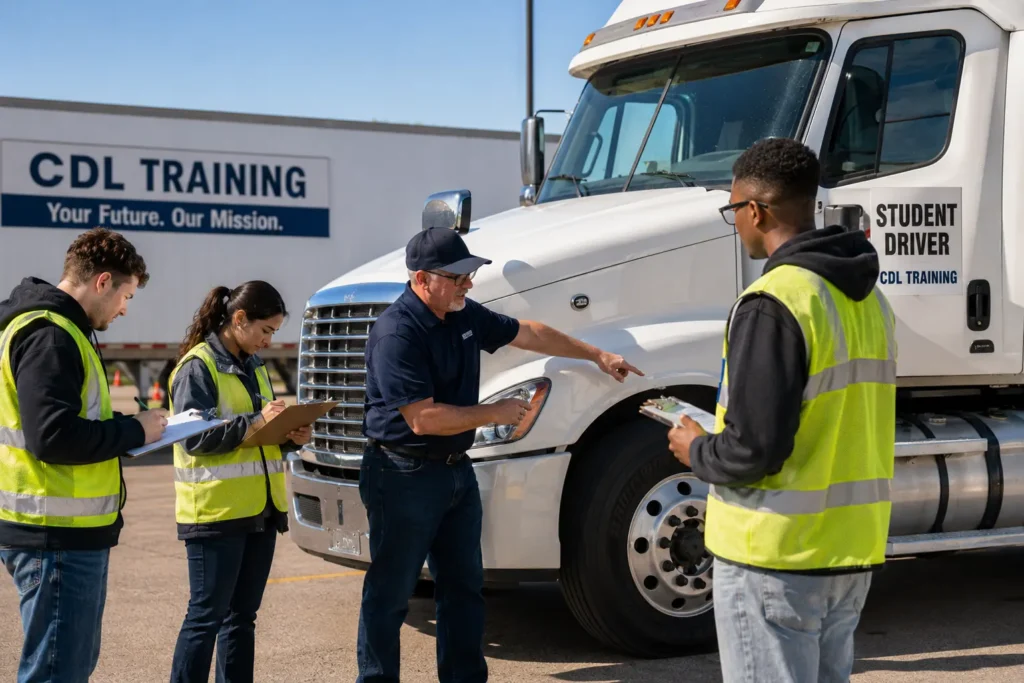
Behind-the-wheel training is where you develop the hands-on skills needed to operate a commercial vehicle safely. This includes vehicle inspection, backing maneuvers, and road driving under the guidance of experienced instructors.
Step 4 – Pass the CDL Skills Test
The CDL Skills Test has three components: a pre-trip inspection, basic vehicle control, and a road driving test. You must pass all three to receive your CDL.
Step 5 – Receive Your CDL Certification
After passing the Skills Test, the Texas DPS will process your CDL. At this point, you’re certified to operate commercial vehicles and ready to apply for CDL driver jobs.
Why Professional CDL Training Matters
What You’ll Learn in CDL School
CDL school covers both the theoretical and practical knowledge required to pass the certification exam and perform safely on the job. Core training areas include:
- Vehicle Inspection Procedures: Learning to identify mechanical defects before a trip
- Backing Maneuvers: Parallel parking, alley docking, and straight-line backing
- Road Safety: Following distance, speed management, and hazard recognition
- Defensive Driving Techniques: Anticipating the behavior of other drivers to avoid accidents
Benefits of Hands-On CDL Training
Reading the CDL manual is important—but classroom knowledge alone doesn’t prepare you for real-world driving. Hands-on training builds the muscle memory and situational awareness that written study can’t replicate. Students who complete structured, behind-the-wheel training consistently perform better on the CDL Skills Test.
How Roadmasters Academy Helps Students Build Real-World Driving Skills
Roadmasters Academy offers Class A CDL training and Class B CDL training designed around practical, career-focused instruction. Key features of the program include:
- Experienced Instructors: Trainers with real-world commercial driving backgrounds
- Modern Training Vehicles: Students train on up-to-date equipment that mirrors what they’ll encounter on the job
- Texas CDL Test Preparation: Structured preparation for both the knowledge exam and the CDL Skills Test
- Personalized Guidance: Instructors work with students individually to address weaknesses before test day
Roadmasters Academy’s hands-on instruction approach means students don’t just pass the test—they enter the workforce with the skills employers actually value.
How Much Does CDL Training Cost in Texas?
Factors That Affect Tuition for CDL Training
Tuition for CDL training varies based on several factors:
- Program Type: Class A programs typically cost more than Class B programs due to longer training hours
- Training Hours: More behind-the-wheel time generally means higher tuition
- Equipment Access: Schools with newer, better-maintained equipment may charge more
- Additional Endorsements: Adding endorsements such as the Air Brake Endorsement or Hazmat certification increases overall cost
Average Tuition for CDL Training
CDL training programs in Texas typically range from $3,000 to $10,000, depending on the school and program type. Class A programs tend to fall toward the higher end of that range.
Financial Assistance and Tuition Assistance Programs
Several options exist to help offset the cost of CDL training:
- Workforce Solutions programs: Texas-based workforce development agencies sometimes fund CDL training for eligible applicants
- Employer-sponsored training: Some trucking companies pay for CDL training in exchange for a commitment to drive for them after certification
- Veterans benefits: Eligible veterans may use GI Bill benefits toward CDL programs
Is CDL Training Worth the Investment?
For most people, yes. A fully loaded Class A CDL driver can earn $60,000–$80,000 or more annually, which means the return on a $5,000–$8,000 training investment can be recovered within the first few months of employment.
How to Prepare for the CDL Knowledge Test
What Topics Are Covered on the CDL Exam?
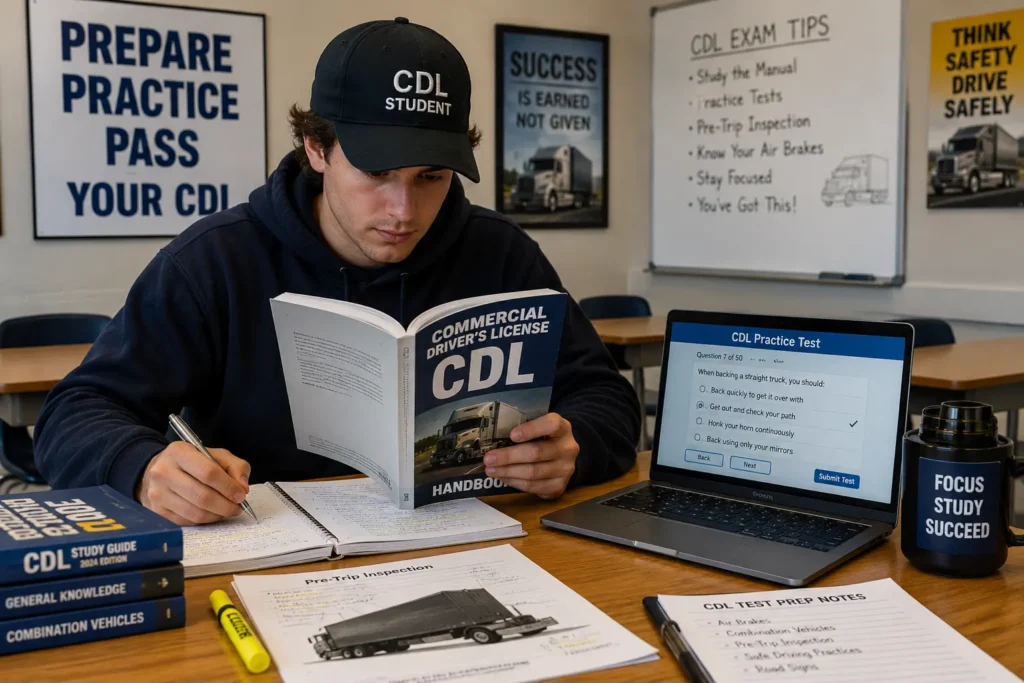
The CDL knowledge test covers several subject areas. All applicants must pass the General Knowledge exam. Depending on the license class and endorsements sought, additional tests may include:
- Air Brakes: Required for vehicles equipped with air brake systems
- Combination Vehicles: Required for Class A CDL applicants
- Vehicle Inspection: Covers pre-trip and post-trip inspection procedures
Common Test Questions for CDL Applicants
Knowing the format of test questions can reduce anxiety and improve performance. Here are a few representative examples:
Example Question #1
What should you do when driving in heavy rain?
Reduce speed, increase following distance, and avoid sudden steering or braking inputs. If visibility drops too low, pull safely off the road and wait for conditions to improve.
Example Question #2
What is the minimum tread depth for front tires on a commercial vehicle?
4/32 of an inch for front tires. Steer tires must meet this standard because front tire failure at highway speeds can cause a driver to lose control.
Example Question #3
When are you required to stop at a railroad crossing?
Buses, vehicles carrying hazardous materials, and vehicles with placards must always stop at railroad crossings, regardless of whether a train is visible.
Using CDL Practice Tests to Improve Your Chances of Passing
Why CDL Practice Tests Matter
CDL test practice tests simulate the actual exam environment, helping applicants identify weak areas before test day. Candidates who regularly take practice exams are statistically more likely to pass on the first attempt—saving time, money, and stress.
How Often Should You Take Practice Exams?
A consistent study routine produces the best results. Aim to take at least one CDL practice test per day in the two weeks leading up to your exam. A CDL Class A practice test should cover all relevant sections: general knowledge, air brakes, and combination vehicles.
Best Strategies for Exam Success
- Study the CDL Manual: The Texas CDL Handbook is the primary source for all exam questions. Read it thoroughly before taking practice tests.
- Take Timed Practice Tests: Simulating the time pressure of the real exam helps with pacing.
- Focus on Weak Areas: Use practice test results to identify which topics need more attention.
- Review Missed Questions: Don’t just note the wrong answer—understand why the correct answer is right.
What Happens During the CDL Skills Test?
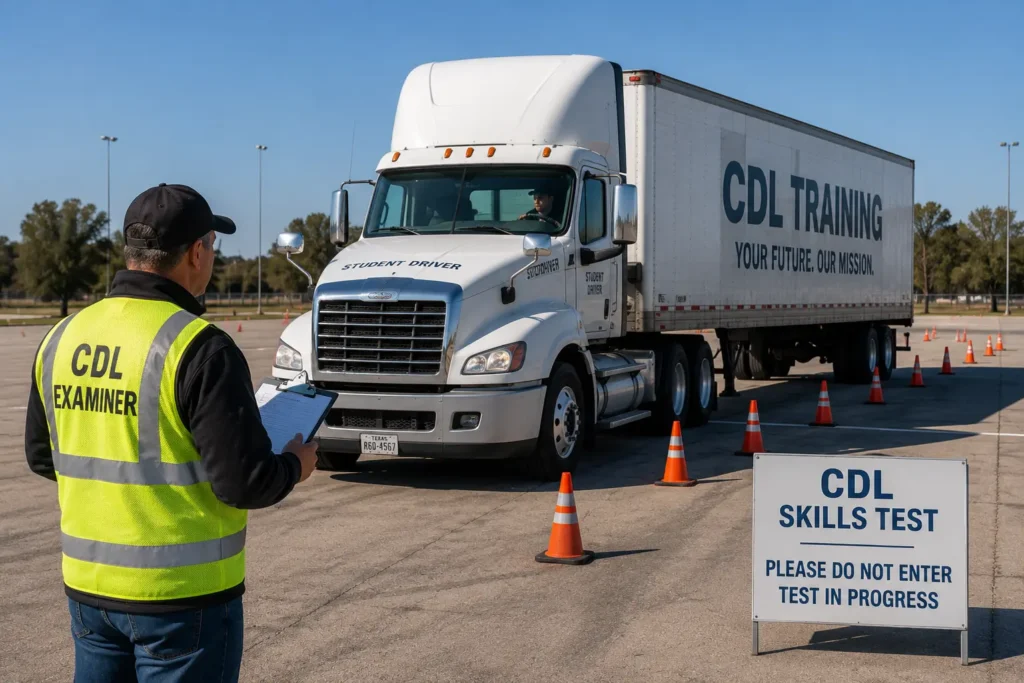
Pre-Trip Inspection Test
The examiner will ask you to perform a vehicle inspection and explain what you’re checking and why. This tests your ability to identify defects that could make the vehicle unsafe to operate.
Basic Vehicle Control Test
This section evaluates your ability to maneuver the vehicle in tight spaces. Exercises typically include straight-line backing, alley docking, and parallel parking.
Road Driving Test
During the road portion, the examiner rides along as you drive a set route. You’ll be evaluated on observation habits, lane positioning, speed management, and compliance with traffic laws.
Common Mistakes That Cause Students to Fail
- Incomplete pre-trip inspection (missing key components)
- Failing to observe railroad crossings properly
- Poor mirror usage during backing maneuvers
- Insufficient following distance on the road test
- Touching or rolling past cones during basic control exercises
Completing structured behind-the-wheel training before your test date significantly reduces the likelihood of making these mistakes.
CDL Jobs Available After Certification
Entry-Level CDL Jobs for New Drivers
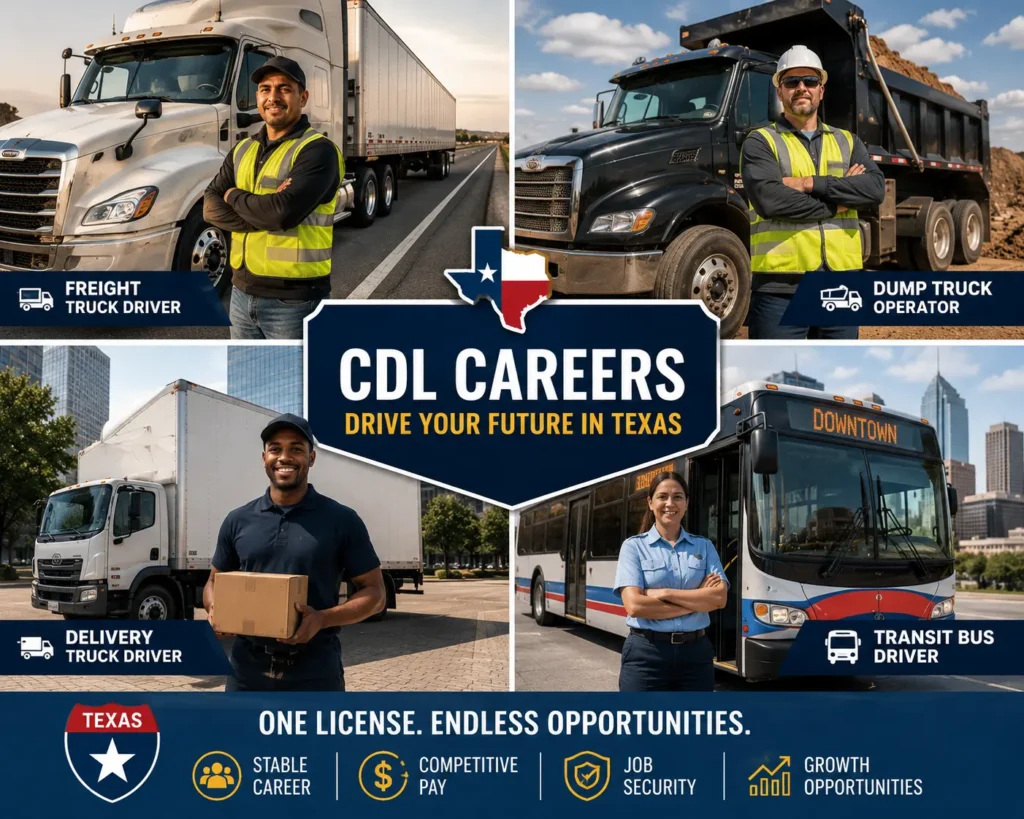
A lack of experience doesn’t have to be a barrier. Several CDL jobs that require no experience make it possible to start your career right after certification:
- Local Delivery Driver: Short routes, regular hours, home nightly
- Yard Driver: Moving trailers within a warehouse or distribution facility
- Bus Driver: Municipal or school bus routes—no OTR experience required
- Construction Driver: Operating dump trucks or flatbeds on job sites
Popular CDL Driver Jobs in Texas
Texas’s size and economic activity create a wide range of CDL driver jobs across the state:
- Freight Driver: Moving goods between distribution centers and retailers
- Regional Truck Driver: Covering multi-state routes with regular home time
- Municipal Driver: Operating sanitation or utility vehicles for city agencies
- Utility Vehicle Operator: Supporting oil, gas, or infrastructure projects
Career Opportunities with a Class A CDL
CDL A jobs offer some of the broadest career flexibility in commercial driving:
- Over-the-Road Trucking: Long-haul routes with premium pay per mile
- Dedicated Routes: Consistent lanes for a single shipper—predictable schedules
- Specialized Freight: Flatbed, tanker, or oversized loads with premium pay rates
Career Opportunities with a Class B CDL
Class B CDL jobs and CDL B jobs are plentiful across Texas:
- Box Truck Driver: Delivering appliances, furniture, or packages on local routes
- Dump Truck Driver: Supporting construction and excavation projects
- Transit Driver: Operating city buses for municipal transportation authorities
- Delivery Fleet Driver: Working for large retail or logistics companies
Skills Employers Look for in CDL Drivers
Safety Awareness
Employers prioritize drivers who understand and follow safety protocols. A clean driving record and demonstrated knowledge of vehicle inspection procedures make a strong impression.
Time Management
Commercial driving jobs often involve strict delivery windows. Employers value drivers who can plan routes efficiently and meet deadlines without cutting corners on safety.
Communication Skills
Drivers frequently interact with dispatchers, customers, and warehouse staff. Clear, professional communication reduces misunderstandings and builds trust.
Vehicle Inspection Knowledge
Drivers who can spot mechanical issues before they become problems save employers significant money. This skill is developed through proper CDL training and reinforced by daily pre-trip and post-trip inspections.
Professionalism and Reliability
Showing up on time, presenting professionally, and maintaining a respectful attitude are qualities that lead to better pay, better routes, and faster advancement.
Frequently Asked Questions About CDL Certification in Texas
How long does it take to get a CDL in Texas?
The full process—from obtaining your Commercial Learner’s Permit to passing the CDL Skills Test—typically takes 3 to 7 weeks, depending on the training program and how quickly you complete your required hours.
What is the difference between Class A and Class B CDL?
A Class A CDL covers combination vehicles (e.g., tractor-trailers), while a Class B CDL covers single vehicles over 26,000 pounds that are not pulling a heavy trailer (e.g., dump trucks, buses). Class A provides access to more vehicle types and generally higher pay; Class B offers a faster path to certification and more local work opportunities.
Can I get CDL jobs with no experience?
Yes. Many entry-level CDL jobs no experience required exist, including yard driver positions, local delivery routes, and bus driving roles. Some carriers also offer paid training programs for new CDL holders.
How much does CDL training cost?
CDL training in Texas typically costs between $3,000 and $10,000. Class A programs are generally more expensive than Class B programs. Financial assistance may be available through workforce programs, employer sponsorships, or veterans’ benefits.
Are CDL practice tests helpful?
CDL practice tests are one of the most effective study tools available. They reinforce key concepts, familiarize applicants with question formats, and help identify weak areas before the actual exam.
Is Class B CDL certification worth it?
For drivers who prioritize local work, consistent hours, and a faster entry into the workforce, Class B CDL certification is absolutely worth it. Class B jobs offer stable pay and a manageable lifestyle compared to long-haul trucking.
Start Your CDL Journey With Confidence
Getting your CDL in Texas is a straightforward process when you understand each step and approach your training seriously. From meeting the Texas CDL requirements and passing your CDL permit test, to completing behind-the-wheel training and acing the CDL Skills Test, every stage builds toward a rewarding career in commercial driving.
Quality training makes the difference between passing on your first attempt and spending extra time and money on retests. It also prepares you to perform well on the job—not just on exam day.
Ready to start your CDL training? Roadmasters Academy provides hands-on Class A and Class B CDL training with experienced instructors, modern equipment, and practical guidance designed to prepare students for certification and careers in commercial driving. Whether you’re pursuing Class B CDL certification for local routes or a Class A license for long-haul opportunities, Roadmasters Academy gives you the skills to move forward.
CDL driver jobs are waiting. The road starts here.